Laser Diffraction vs Dynamic Light Scattering: Which Particle Size Analyzer Is Best?
When you need to measure particle size, choosing the right analyzer can be tricky. Laser diffraction offers quick results across a wide size range Particle Size Distribution testing, but dynamic light scattering shines when you’re working with nanoparticles. Your decision hinges on factors like sample type, accuracy, and speed. Before you settle on one method, it’s important to understand how each works and what trade-offs you might face.
How to Choose Between Laser Diffraction and Dynamic Light Scattering
When deciding between laser diffraction and dynamic light scattering Lab Alliance, you’ll want to think about the size range and concentration of your particles.
Laser diffraction excels with larger particles, typically from about 0.1 microns up to a few millimeters, making it ideal when you need to analyze broad size distributions quickly.
On the other hand, dynamic light scattering shines with nanoparticles, often below 1 micron, offering precise measurements for very small particles but requiring dilute samples to avoid multiple scattering effects.
Your choice depends on whether you prioritize measuring fine details in tiny particles or handling a wider range with higher concentrations.
How Laser Diffraction Measures Particle Size
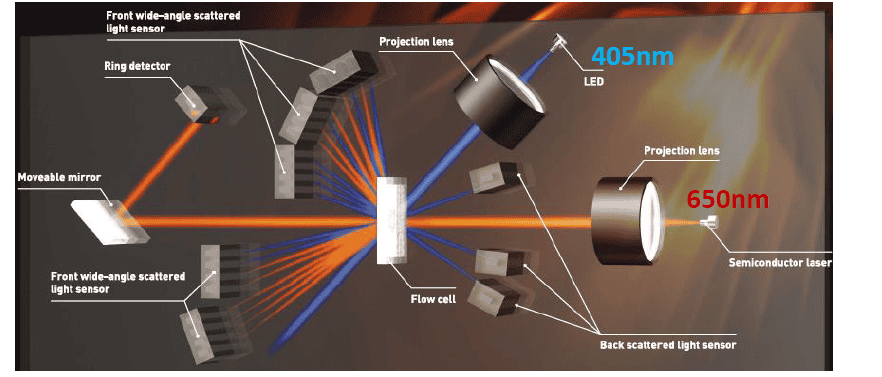
Choosing laser diffraction means you’re relying on a method that measures particle size by analyzing how a laser beam scatters as it passes through a sample.
When the laser hits particles, they scatter light at angles inversely related to their size—larger particles scatter light at smaller angles, while smaller ones scatter it at wider angles.
You capture this scattering pattern with detectors positioned around the sample.
By applying mathematical models like the Mie theory, the analyzer converts these scattering patterns into a detailed particle size distribution.
This process lets you quickly and accurately measure a broad range of particle sizes in one go.
Laser diffraction gives you the freedom to analyze powders, suspensions, or emulsions with minimal sample prep, empowering you to get reliable size data fast and move forward confidently.
Why Dynamic Light Scattering Excels at Small Particle Size Analysis
Because Dynamic Light Scattering (DLS) analyzes fluctuations in scattered light intensity caused by the Brownian motion of particles, it excels at detecting very small particles, often in the nanometer range.
When you need detailed insights into nanoparticles or fine colloids, DLS provides the sensitivity and resolution you require. It measures particle size based on how quickly particles move, giving you precise data on tiny particles that other methods might miss.
You won’t be limited by large sample volumes or complex preparation steps, so you can quickly assess your samples with minimal hassle.
If you want freedom in analyzing small particles with accuracy and ease, DLS is a tool designed to meet that need efficiently and reliably.
Comparing Accuracy and Speed: Laser Diffraction vs. DLS
Dynamic Light Scattering offers impressive sensitivity for analyzing tiny particles, but you might wonder how it compares to Laser Diffraction regarding accuracy and speed.
When it comes to accuracy, Laser Diffraction excels at measuring a broad size range quickly and reliably, giving you consistent results for larger particles. DLS shines with nanoparticles, providing detailed size distribution for very small particles, though it may struggle with polydisperse samples.
Regarding speed, Laser Diffraction generally delivers faster measurements, letting you process many samples efficiently. DLS, while slightly slower, gives you deeper insights into particle dynamics but requires more careful sample preparation.
Ultimately, your choice depends on whether you prioritize quick, broad-range data or highly sensitive analysis at the nanoscale, giving you the freedom to match the method to your needs.
How Much Does Each Analyzer Cost and What’s the Maintenance Like?
While both Laser Diffraction and DLS analyzers offer valuable insights, their costs and maintenance needs can differ markedly.
Laser Diffraction systems typically come with a higher upfront price, often ranging from $30,000 to $80,000, but they’re built for durability and easier upkeep. You’ll spend less time on routine cleaning and calibrations, giving you more freedom to focus on results.
DLS analyzers tend to be more affordable initially, usually between $15,000 and $50,000, but they require more frequent maintenance. The sensitive optics and laser components need careful handling and regular calibration, which can add to your time and cost in the long run.
Choosing between them means balancing your budget with how much hands-on care you’re willing to provide.
Conclusion
When choosing between laser diffraction and dynamic light scattering, consider your particle size range and precision needs. If you need quick, broad-range measurements from powders to large particles, laser diffraction is your go-to. But for detailed, sensitive analysis of nanoparticles under one micron, DLS is better. Think about accuracy, speed, cost, and maintenance to match your sample type and budget. Selecting the right tool guarantees reliable results without overspending or compromising quality.